Photo Therapy
Last updated: October 2026 · Information reviewed by Dr. K. K. Das, Founder, Surgy Centre, Bokaro Steel City (in surgical practice since 1977)
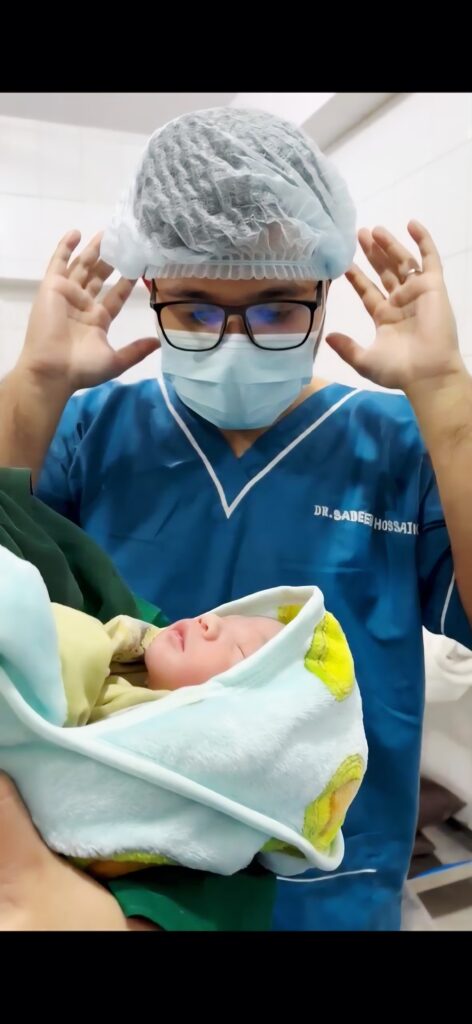 Phototherapy for newborn jaundice
Photo Therapy for Newborn Jaundice — safe, monitored treatment in Bokaro Steel City
Jaundice is the most common condition of newborn babies: the yellow tint of skin and eyes that appears in most infants in their first week, as their immature livers process the breakdown of surplus red blood cells. In the great majority it is mild and monitored; in a meaningful minority, bilirubin levels climb to where treatment matters — and here modern medicine has an elegant, safe answer: phototherapy. Blue-spectrum light transforms bilirubin in the skin into a form the baby’s body can excrete without liver processing, and the level falls day by day. At Surgy Centre, Bokaro Steel City, phototherapy units run inside our newborn unit around the clock, with in-house bilirubin testing (laboratory) and paediatric oversight — since Dr. K. K. Das founded the hospital in 1977, no jaundiced newborn has needed to travel elsewhere for this care.
Worried about your baby’s yellowness? Call 88770 88770 / 73710 50505 — jaundice checks are quick, and reassurance or treatment is same-day.
Phototherapy for newborn jaundiceUnderstanding newborn jaundice
Physiological jaundice (the normal variant)
Babies are born with extra red blood cells; as these break down, bilirubin rises. The newborn liver — still learning its job — handles it slowly, so levels peak around day 3–5 and fall naturally within a week or two. This physiological pattern affects most babies, needs observation, and needs no treatment when levels stay in the safe zone.
Jaundice that needs treatment
- Levels crossing age-specific thresholds on bilirubin testing
- Rising too fast — speed of rise matters as much as the level
- Breast-milk jaundice — a benign prolonged pattern that nonetheless needs monitoring to distinguish from problems
- Blood-group incompatibility (Rh or ABO) — the mother’s antibodies destroying baby’s cells; levels can climb dangerously fast and need close surveillance from day one
- Infection, prematurity, or inadequate feeding — each worsens jaundice and needs its own correction alongside
The danger that makes treatment non-negotiable
Very high bilirubin crosses into the brain — kernicterus — causing permanent damage: deafness, cerebral palsy, developmental harm. This catastrophe is entirely preventable with timely phototherapy, which is precisely why “wait and watch” advice from untrained corners is dangerous. Thresholds and timing are medical decisions based on the baby’s age in hours, weight and risk factors — not on how yellow the baby looks.
Phototherapy for newborn jaundiceHow phototherapy works — and how we run it
- The light — special blue-spectrum lamps (or LED units) at the exact wavelengths that convert skin bilirubin to excretable forms; the baby lies under the light, minimally clothed, eyes shielded with soft patches
- Round-the-clock exposure — interrupted only for feeding and care; continuous exposure is what makes it work
- Monitoring — bilirubin levels rechecked at intervals our paediatric team sets (typically 12–24 hours), temperature watched on warmers where needed (radiant warmers), hydration maintained with frequent feeding
- Feeding first — jaundice and feeding are entwined: a well-fed baby excretes bilirubin faster; our nurses support breastfeeding through phototherapy rather than around it
- Intensity per need — standard units first; fiberoptic blankets added for higher levels; escalation thresholds decided in advance, not in panic
Phototherapy for newborn jaundiceWhat families experience — the honest version
Most babies are under lights for 1–3 days. The baby looks a bit “sunned” (the light tints everything); eye patches go on and off with feeds; weights are checked daily because light exposure and feeding both affect them; and mothers stay close — expressing milk, feeding between light intervals, holding the baby during care breaks. Our unit keeps mother and baby together in the same building (maternity wards adjacent to the newborn unit) — separation stress is a real harm we deliberately design out. Discharge follows a confirmed falling trend and a safe level, with a follow-up check scheduled; jaundice returning home advice (feeding frequency, yellowness spreading downward, sleepiness, poor feeding) is given in writing.
Phototherapy for newborn jaundiceWhen levels go beyond phototherapy
Severe or rapidly rising jaundice needs escalation: intensive phototherapy, IV fluids, and in the rare highest zone, exchange transfusion — a level-III capability we refer promptly with the baby stabilised for transport. The point of early, monitored phototherapy is precisely that it makes this rare: babies treated on time almost never reach the exchange zone. Families are told thresholds and plans in advance — the same transparency that governs every service here.
Phototherapy for newborn jaundiceHome checks every family should know
- Look in daylight — press gently on the baby’s nose, chest or thigh; yellow staining on release is the check (yellow spreads head-to-toe as levels rise)
- Feeding rhythm — 8+ feeds a day keeps bilirubin moving out; sleepy babies who won’t feed need checking, not waiting
- Day 3–5 is peak window — the days to be most watchful, and the days a quick visit settles most worries
- Sunlight is NOT phototherapy — window glass blocks the useful wavelengths, overheating and dehydration are real, and relying on the sun has cost babies their hearing. This myth needs to end in every household
Phototherapy for newborn jaundiceContact the newborn unit
Surgy Centre, 225 Cooperative Colony, Bokaro Steel City, Jharkhand 827001. Phototherapy and newborn checks available 24×7; OPD Monday–Saturday 9 AM–12 PM and 3–6 PM. Phone: 88770 88770 / 73710 50505. Related: NICU · Body Warmer · Laboratory · All Treatments.
Phototherapy for newborn jaundiceBilirubin — the pigment, the numbers, the chart
Jaundice management is a numbers discipline built on one pigment and one chart. The pigment: bilirubin — the yellow breakdown product of haemoglobin; the newborn’s surplus red cells plus a slow liver raise it in nearly every baby’s first week. The chart: age-in-hours plotted against threshold curves — a 24-hour-old baby and a 5-day-old baby tolerate very different levels; “the number” only means something against the baby’s hour of life, weight and risk flags (prematurity, incompatibility, illness lower the safe line). The measurement ladder: the transcutaneous (skin-probe) screen, the serum bilirubin (laboratory) where the screen or the picture demands — the serum value being the one the chart actually rules by. The zones: below the phototherapy line — observe, feed, recheck; above it — lights (protocol); in the exchange zone — the rare emergency where intensification and referral run together. The follow-up logic: rechecks at intervals the curve dictates — bilirubin’s trajectory decides, not any single reading. Families should keep one habit from this section: ask “what is the number, and what is the threshold?” — a jaundiced baby’s care is complete when both are on the table.
Phototherapy for newborn jaundiceBlood-group incompatibility — the jaundice that starts before birth
Most jaundice is the liver’s slow start; a minority is the mother’s antibodies at war with the baby’s cells — and that minority follows different rules. Rh disease: the Rh-negative mother carrying an Rh-positive baby — the mother’s immune system, sensitised by a previous pregnancy or missed anti-D prophylaxis, attacks the baby’s cells before and after birth; jaundice arrives in the first 24 hours (the age that makes any jaundice an emergency), climbs fast, and hides anaemia in its wake. ABO disease: the commoner, milder cousin — O-group mothers and A or B babies; later onset, usually phototherapy’s territory. The system that catches both: maternal grouping and antibody screening at the first ANC visit; anti-D injections at the 28-week mark and after deliveries/events for the Rh-negative mother; cord-blood testing at delivery; the first-day bilirubin for flagged babies. The honest reassurance: with the system followed, incompatibility jaundice is caught on schedule and treated on protocol — the tragedies belong to the unregistered pregnancies where nobody checked the blood groups. The five-rupee grouping test at the first visit is, pound for pound, the best-performing rupee in antenatal care.
Phototherapy for newborn jaundiceBreast-milk and breastfeeding jaundice — the pair that confuses everyone
Two different conditions wear similar names and generate unnecessary weaning panic. Breastfeeding (starvation) jaundice: the first-week baby not getting enough milk — poor feeding means poor gut motion means bilirubin recirculating; the treatment is feeding, not weaning — latch help, frequency, expression support from our nursing team. Breast-milk jaundice: the normal, prolonged jaundice of weeks two to twelve in well-feeding, well-growing babies — a milk-chemistry quirk affecting a meaningful share of breastfed infants; harmless, self-resolving, requiring only the monitoring that excludes other causes. The critical distinction: neither condition is a reason to stop breastfeeding; both are reasons to feed better and monitor properly. The weaning warning: families persuaded by relatives to “switch to formula to clear the yellow” usually trade a harmless pattern for a real problem — the baby’s nutrition, the mother’s supply and the bonding all suffer for a jaundice that formula does not meaningfully improve. The rule our unit repeats: yellow baby who feeds well and grows well gets watched; yellow baby who feeds poorly gets fed — properly, with help — and then watched; nobody gets weaned for colour.
Phototherapy for newborn jaundiceInside a phototherapy admission — the day-by-day reality
Day one under the lights is unfamiliar; here is the honest itinerary. The setup: the baby under the unit, minimal clothing, the soft eye-shields on (removed with you during feeds), the temperature probe on, the feeding schedule tightened. The rhythm: light hours interrupted for feeds and cuddles; weights daily (lights and feeding both affect them); bilirubin rechecks at the interval the chart sets — typically 12–24 hours; the mother rooming nearby, expressing on schedule, feeding between light intervals. What you may notice: the bluish glow and its tan on the skin; looser greenish stools (bilirubin leaving — the treatment working); extra sleepiness (mostly jaundice’s own effect, fading as levels fall). The decision points: levels falling on schedule — lights continue or step down; levels stubborn — intensive phototherapy, hydration review, cause hunted; levels in the danger zone — stabilisation and referral (the pathway prepared early). The finish line: a confirmed falling trend below threshold, feeding demonstrated, home with the written jaundice-watch instructions and the follow-up date. Most admissions run two to three days; most parents leave wishing they’d known how routine it would be — which is exactly what this page is for.
Phototherapy for newborn jaundiceThe myths ledger — jaundice edition
Newborn jaundice carries more folklore than any condition we treat; the ledger, settled one by one. “Sunlight cures jaundice”: window glass blocks the useful wavelengths; the baby risks overheating and dehydration while the bilirubin climbs unmeasured — sunlight is not phototherapy, full stop. “Gripe water and herbal drops clear the yellow”: unmeasured sedatives and unknown doses in a newborn liver are the opposite of treatment — several classic preparations have harmed actual babies. “The mother’s milk is causing it — switch to formula”: see the breastfeeding section above — weaning worsens the common cases and solves none. “Putting the baby in the afternoon sun with oil massage”: oil blocks the skin’s heat loss — overheating plus dehydration plus zero effective therapy. “Jaundice means weak liver for life”: physiological jaundice leaves nothing behind; even treated significant jaundice, caught on time, carries no lifelong sentence. “Repeat jaundice means the first treatment failed”: rebound is expected physiology, not failure — one recheck settles it. The ledger’s moral: every myth costs a day of monitoring or a feed of breast milk; the chart costs a drop of blood — the arithmetic of science beats the inheritance of folklore every time a baby’s eyes are measured.
Phototherapy for newborn jaundiceMore Diagnostics & Care

Need a consultation or second opinion?
Book your appointment online or call us directly — our team will confirm your slot within minutes.